Announcement

Collapse
No announcement yet.

Point toes

Collapse
X
 
  • Filter
  • Time
  • Show
Clear All
new posts

  • Khun Kao
    replied


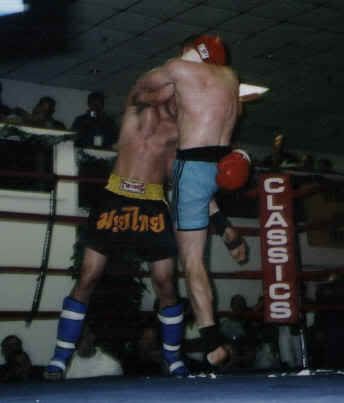
    I thought that I raise my toes during blocks, but the camera doesn't lie! I hold my foot in more of a neutral position during leg checks.

    I do point my toes down as I knee, though!
    Leave a comment:


  • Garland
    replied
    tippy toes down for knees and kicks...tippy toes up for sheilding shit, unless it's a low leg kick, in which case just pivot on the ball of your foot so they catch the shin instead of the calf.

    Leave a comment:


  • Maxx
    replied
    I guess it comes down to whatever you are more comfortable with. Personally I don't point my toes when I check a kick. The reason is that the lower the kick hits, the more leverage it will have. I'm sure that there are people out there that know how to counter this, but in my experience a person who points his toes while checking a kick is at serious risk of having the kick cut low, brush right through the foot and sweep both legs out from under the fighter.

    Leave a comment:


  • twtguy
    replied
    Originally posted by ryangruhn View Post
    Try both yourself for at least a few months each and figure out what works for you. Different strokes for different folks!
    I will...thanks for the advice.

    Leave a comment:


  • ryangruhn
    replied
    There are nerves running along the inside and outside of the shin which, when the toes are flexed the one is covered. Do the test again and feel the nice edge of your shin that is still exposed at the apex. I promise this will still make it hurt for him! From experience, I would rather only one of us hurt than both and that one person being him not me.

    In regards to pointing down to allow for more coverage I have heard this as well and used it from time to time. Each time I come to the conclusion that getting hit in the ankle/foot is worse than the shin. Main reason being that there are so many more small bones and close to zero muscle to protect. I would rather just lower my shin to catch the kick. The one drawback that I have found however is that about one inch of the coverage is your toes pointing towards their shin. When you catch their kick with your toes, it sucks. This however has only happened a few time to me and I have found the pay off is less with the flex than it is with pointing the toes down.

    My conclusion for you is:

    Try both yourself for at least a few months each and figure out what works for you. Different strokes for different folks!

    Gruhn

    Leave a comment:


  • twtguy
    replied
    Originally posted by thai_me View Post
    The reason for pointing toes down while checking is because it gives you an extra half a foot (pun intended) cover between you and the kicker. Every bit counts. You also wouldnt want to soften your check by curling up your foot and putting your muscle in the way of your shin. This would just soften the blow for your oponent. Again this is just how I have been taught.
    Good point...don't want that.

    Leave a comment:


  • thai_me
    replied
    The reason for pointing toes down while checking is because it gives you an extra half a foot (pun intended) cover between you and the kicker. Every bit counts. You also wouldnt want to soften your check by curling up your foot and putting your muscle in the way of your shin. This would just soften the blow for your oponent. Again this is just how I have been taught.

    Have a look at how Buakaw knees and checks. Both are with toes pointed down. Not to say that Buakaw is the be all and end all of thai technique either, but the way he does it is exactly the same way i have been taught. Different strokes for different folks I guess.

    Leave a comment:


  • twtguy
    replied
    Originally posted by ryangruhn View Post
    Here is a simple test you can do on your own to show you why to flex when doing a shin up block. In a sitting position point your toes down and feel how much of your shin is exposed (outside side). Also take note what parts are exposed. Now flex your toes up and feel again. You will see that a lot less of the front shin bone (sorry for the lack in technical terms) is exposed making it safer for you, the person who is shin up blocking.

    Gruhn
    I gave it a try. When I pointed my toes outward (not downward), my shin seems to be protected more by the muscles. I guess outward is the way to go for checking...for more than one reason.

    Leave a comment:


  • ryangruhn
    replied
    Here is a simple test you can do on your own to show you why to flex when doing a shin up block. In a sitting position point your toes down and feel how much of your shin bone is exposed (outside side) as apposed to muscle. Also take note what parts of the bone are exposed. Now flex your toes up and feel again. You will see that a lot less of the front shin bone (sorry for the lack in technical terms) is exposed as there is more muscle covering it which makes it safer for the shin of the person who is doing the shin up block.

    Gruhn

    Leave a comment:


  • twtguy
    replied
    Originally posted by thai_me View Post
    Ive always been taught to point the toes down, no matter what knee you are doing. Same goes for checking too.
    hmmm thats interesting. Why when checking? You dont really need a sharp knee or explosive power from the calf. I was told that you should point your toes out when you check. This was because if you go to step back down and distribute some weight to your lead foot and they kick you on the way down, breaking your balance, you might break or jam your toes if they are pointed downward and you land on them. This would in turn make you fall over. Have I been taught wrong? What do you guys think about this?

    Leave a comment:


  • thai_me
    replied
    Ive always been taught to point the toes down, no matter what knee you are doing. Same goes for checking too.

    Leave a comment:


  • Tim Mousel
    replied
    Raising the toes where they are pulled up towards the shin is called dorsi-flexion. As you point out, that is the foot position Ajarn Chai teaches while throwing curve knees and blocking kicks.

    Tim

    Leave a comment:


  • ryangruhn
    replied
    Then, Tim you and I are on the same page. My mistake regarding the technical lingo You may however be able to assist me in finding out the technical term for raising the toes. Any idea?

    Gruhn

    Leave a comment:


  • Tim Mousel
    replied
    Originally posted by ryangruhn View Post
    The curved knees however the toes were to be pointing up as with the shin up block so as Tim explains it would be plantar flexed.
    Just to clarify....plantar flexion is toes pointed down which is what I was saying to do with the straight knees. Not sure if there was a misunderstanding here, but just wanted to clarify....

    Tim

    Leave a comment:


  • ryangruhn
    replied
    I have seen both taught but recently was corrected by Ajarn to have my toes pointed directly down for straight knees and skip knees. The curved knees however the toes were to be pointing up as with the shin up block so as Tim explains it would be plantar flexed. The shin up block is obvious as it gives the shin some extra padding via the muscle but the knees are less obvious of why to point the toes down. From my experience (broken toes mind you) I have learned to keep my toes down so I don't jam them into my opponent. However, different strokes for different folks. If it works for you to point them go ahead and do it.

    Gruhn

    Leave a comment:

Working...
X